Quick Overview
The applicable temperature range of seamless pipes (SMLS) typically spans -196°C to 850°C, depending on material grade, alloy composition, and heat treatment condition.
Carbon steel pipes: -29°C to 425°C
Low-temperature pipes: down to -45°C
Alloy (Cr-Mo) pipes: up to 650°C
Stainless steel pipes: -196°C to 850°C
Selecting the correct temperature range is critical to avoid brittle fracture (low temp) and creep failure (high temp).
1. Carbon Steel Seamless Pipes Temperature Range
Carbon steel seamless pipes are widely used due to cost-efficiency and stable mechanical properties.
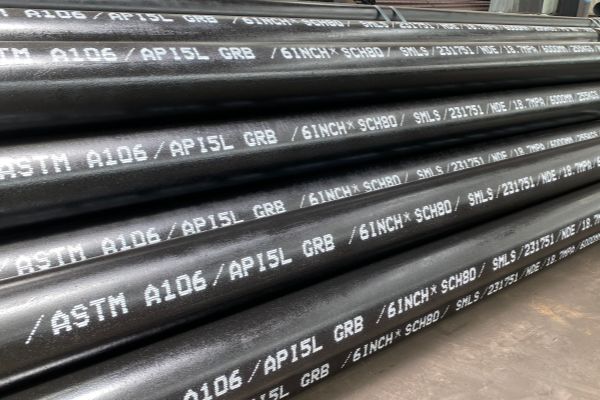
ASTM A106 Gr.B
Temperature Range: -29°C to 425°C (up to 450°C short-term)
Features: Good high-temperature strength and weldability
Applications: Petrochemical pipelines, power plant piping, high-temperature fluid transport
ASTM A53 Gr.B
Temperature Range: -29°C to 400°C
Features: General-purpose pipe, slightly lower heat resistance than A106
Applications: Water systems, compressed air, structural use
ASTM A106 Gr.C
Temperature Range: -29°C to 425°C
Features: Higher strength due to higher carbon content
Applications: High-pressure pipelines, oil & gas transmission
2. Low Alloy Seamless Pipes Temperature Range
Low alloy steels enhance low-temperature toughness and medium-temperature strength.
ASTM A333 Gr.6
Temperature Range: -45°C to 425°C
Key Advantage: Excellent impact resistance at low temperatures
Applications: LNG systems, cryogenic pipelines, cold-region infrastructure
API 5L Gr.B
Temperature Range: -20°C to 400°C
Features: Balanced strength and weldability
Applications: Oil & gas transmission pipelines
3. Chromium-Molybdenum Alloy Pipes (High Temperature)
Designed for high-temperature, high-pressure environments.
ASTM A335 P11 / P22
Temperature Range:
P11: up to 575°C
P22: up to 600°C
Features: Strong creep resistance, oxidation resistance
Applications: Boiler systems, refinery heaters, steam pipelines
ASTM A335 P91
Temperature Range: up to 650°C
Features: Superior creep strength, reduced wall thickness possible
Applications: Ultra-supercritical power plants, main steam pipelines
4. Stainless Steel Seamless Pipes Temperature Range
Stainless steel provides the widest temperature adaptability and corrosion resistance.
ASTM A312 TP304 / 304L
Temperature Range: -196°C to 750°C (800°C short-term)
Features: Excellent cryogenic and oxidation resistance
Applications: Food processing, chemical systems, cryogenic tanks
ASTM A312 TP316 / 316L
Temperature Range: -196°C to 850°C
Features: Enhanced corrosion resistance (Mo content)
Applications: Marine, chemical, nuclear auxiliary systems
ASTM A312 TP321 / 347
Temperature Range: up to 900°C
Features: Stabilized grades with superior intergranular corrosion resistance
Applications: High-temperature chemical and aerospace systems
5. Key Temperature Selection Considerations
1. Avoid Over-Temperature Operation
Exceeding limits can cause:
Creep deformation
Pipe rupture
Pressure failure
2. Low-Temperature Risk Control
Below -29°C, standard carbon steel may become brittle
Use low-temperature certified materials (e.g., A333)
3. High-Temperature Applications
Use Cr-Mo alloy pipes (A335 series) for steam/boilers
Avoid carbon steel in high-temp steam systems
4. Thermal Cycling Conditions
Select heat-treated pipes
Design for thermal expansion and stress relief
Conclusion
The temperature applicability of seamless pipes ranges from cryogenic (-196°C) to ultra-high temperature (850°C+).
For safe and reliable pipeline operation, engineers must match:
Material grade
Operating temperature
Pressure conditions
Corrosion environment
Proper selection ensures long service life, structural integrity, and operational safety.
FAQ
1. What is the maximum temperature for seamless steel pipes?
Most seamless steel pipes can operate up to 425°C (carbon steel), while alloy and stainless steel pipes can reach 650°C–850°C depending on grade.
2. What is the lowest temperature seamless pipes can handle?
Low-temperature and stainless steel pipes can operate down to -196°C, suitable for LNG and cryogenic applications.
3. Can carbon steel pipes be used in low temperatures?
Standard carbon steel is not recommended below -29°C due to brittle fracture risk. Use ASTM A333 instead.
4. Which seamless pipe is best for high-temperature applications?
ASTM A335 P91 and stainless steel TP321/347 are preferred for high-temperature and high-pressure systems.


 English
 Español
 Français
 بالعربية