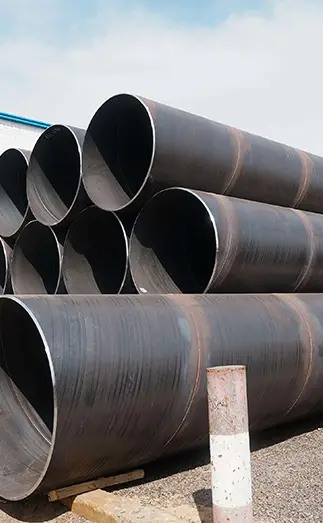
JCOE and UOE are the two most widely used forming processes for manufacturing LSAW (Longitudinal Submerged Arc Welded) steel pipes.
Both processes form steel plates into large-diameter pipes for high-pressure and structural applications, but they differ significantly in forming sequence, production efficiency, dimensional flexibility, and equipment investment.
Understanding the differences between JCOE and UOE forming is critical for selecting the right LSAW pipe for oil & gas pipelines, offshore structures, pressure vessels, and large-scale infrastructure projects.
What Is the JCOE Forming Process?
JCOE is a progressive step-by-step forming process, named after its four main stages: J-Forming, C-Forming, O-Forming, and Expanding.
JCOE Forming Steps
J-Forming
The steel plate is partially bent into a “J” shape using a hydraulic press.
C-Forming
Further pressing transforms the “J” shape into a “C” shape.
O-Forming
The plate edges are closed to form a circular “O” shape, creating the pipe shell.
Expanding
After internal and external submerged arc welding, the pipe is mechanically or hydraulically expanded to achieve precise diameter, improve roundness, and reduce residual stress.
Key Characteristics of JCOE
Uniform plate deformation with low residual stress
Minimal surface damage during forming
High flexibility in diameter and wall thickness
Particularly suitable for thick-wall and customized LSAW pipes
Because the forming pressure is applied progressively, JCOE equipment can produce multiple pipe sizes with the same forming unit, making it ideal for small-batch, multi-specification orders.
What Is the UOE Forming Process?
UOE is a highly automated, high-efficiency forming process consisting of three main steps: U-Forming, O-Forming, and Expanding.
UOE Forming Steps
U-Forming
The steel plate is bent into a “U” shape using a large hydraulic press.
O-Forming
The “U” shape is further pressed into a closed circular “O” shape.
Expanding
The welded pipe is expanded to its final diameter to ensure dimensional uniformity and relieve forming stress.
Key Characteristics of UOE
High production automation
Excellent dimensional consistency
Stable and repeatable product quality
Best suited for large-volume production of a single pipe size
However, UOE lines typically require higher capital investment, larger plant space, and are limited to a narrower diameter range per forming set.
JCOE vs UOE: Key Differences
Production Efficiency
UOE offers significantly higher productivity due to fewer forming steps.
Typical annual capacity:
JCOE: ~100,000–250,000 tons
UOE: ~300,000–1,000,000 tons
UOE is ideal for mass production, while JCOE favors flexibility over speed.
Dimensional Range and Flexibility
JCOE supports a wider range of diameters and thicker walls under the same press capacity.
A single JCOE forming unit can manufacture multiple pipe diameters.
UOE forming machines are diameter-specific, limiting size variation without equipment change.
Equipment Investment
JCOE requires lower forming force and relatively flexible tooling.
UOE requires heavy-duty presses, higher investment, and larger production lines.
Super Steel Recommendation
At Super Steel, we do not treat JCOE and UOE as competing technologies, but as complementary solutions.
The optimal choice depends on:
Pipe diameter and wall thickness
Project volume
Delivery schedule
Applicable standards (API 5L, ASTM, EN, ISO)
Our technical team supports customers in selecting the most cost-effective and technically appropriate LSAW forming process for each project.
FAQ:
Q1: What does JCOE stand for in LSAW pipe manufacturing?
A1: JCOE stands for J-Forming, C-Forming, O-Forming, and Expanding.
Q2: Which forming process is better for thick-wall LSAW pipes?
A2: JCOE forming is better suited for thick-wall and customized LSAW pipes.
Q3: Why is UOE forming more efficient than JCOE?
A3: UOE has fewer forming steps and higher automation, enabling higher production capacity.
Q4: Can one UOE line produce multiple pipe diameters?
A4: No. Each UOE O-forming unit is typically designed for a single pipe diameter.
Q5: Which LSAW forming process offers greater dimensional flexibility?
A5: JCOE forming provides greater flexibility in diameter and wall thickness.


 English
 Español
 Français
 بالعربية