In the manufacturing of cold-drawn steel pipes, the annealing process—often referred to in practice as return heating—is not optional or redundant. It is a critical metallurgical step that directly determines dimensional stability, mechanical performance, and long-term service reliability.
To understand why annealing is necessary, it is essential to first examine how the cold-drawing process affects steel pipes.
Impact of Cold Drawing on Steel Pipes
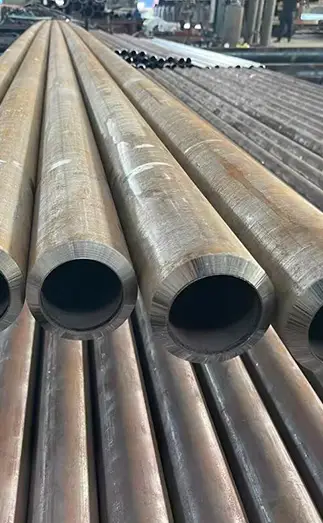
Cold drawing forms steel pipes by pulling them through a die at room temperature. This process significantly improves dimensional accuracy, surface finish, and strength. However, it also introduces two unavoidable side effects:
High residual internal stress
Severe work hardening with reduced ductility
Without annealing, these effects compromise both manufacturability and service performance.
1. Annealing Eliminates Residual Stress and Prevents Deformation
During cold drawing, plastic deformation is not uniform across the pipe wall. Differences between the outer surface, inner surface, and core layer create locked-in residual stresses.
These stresses can cause:
Ovality or warping during cutting and machining
Cracking during welding or forming
Accelerated fatigue failure under cyclic loads
Reduced service life in corrosive environments
Annealing addresses this by heating the cold-drawn steel pipe to a controlled temperature—typically 500–650°C—and holding it for a defined period. This allows atomic diffusion and stress relaxation, releasing approximately 80–95% of residual stress, restoring internal stress balance and ensuring dimensional stability.
2. Annealing Relieves Work Hardening and Restores Toughness
Cold drawing elongates and distorts grains, increasing strength and hardness while sharply reducing plasticity and elongation. The pipe becomes strong but brittle, making it unsuitable for bending, flaring, stamping, or further forming.
Annealing promotes recovery and recrystallization, transforming elongated grains into uniform equiaxed structures. This restores ductility while retaining sufficient strength.
For example:
After annealing, Q345B cold-drawn steel pipes typically show a 15–20% reduction in yield strength
Elongation can increase by over 30%, meeting requirements for automotive, machinery, and structural applications
3. Annealing Optimizes Microstructure and Improves Long-Term Performance
Cold-drawn steel pipes often exhibit:
Uneven grain size
Localized structural defects
Reduced corrosion and fatigue resistance
Annealing refines grain structure and improves uniformity, resulting in:
Enhanced fatigue resistance under alternating loads
Improved stress corrosion cracking resistance
Better consistency in subsequent heat treatment
For multi-pass cold drawing, annealing between passes is indispensable. Without it, excessive work hardening can cause drawing failure or pipe breakage during the next reduction stage.
Conclusion
Cold drawing strengthens and shapes steel pipes but also introduces internal stress and brittleness. Annealing is the essential counter-process that:
Relieves residual stress
Restores plasticity and toughness
Refines microstructure
Ensures dimensional stability and service reliability
Rather than being an energy-intensive add-on, annealing is a mandatory quality-control step in cold-drawn steel pipe production, ensuring the final product meets both precision and performance requirements.
FAQ
Q1: Why is annealing required after cold drawing steel pipes?
Annealing removes residual stress and reverses work hardening caused by cold drawing, restoring ductility and dimensional stability.
Q2: What happens if cold-drawn steel pipes are not annealed?
Unannealed pipes may deform, crack, or fail prematurely due to high internal stress and reduced toughness.
Q3: What temperature is used for annealing cold-drawn steel pipes?
Typical annealing temperatures range from 500°C to 650°C, depending on steel grade and application.
Q4: Does annealing reduce the strength of cold-drawn steel pipes?
Yes, slightly—but it significantly improves elongation, toughness, and overall reliability.
Q5: Is annealing necessary for multi-pass cold drawing?
Yes. Intermediate annealing is essential to restore plasticity before further drawing operations.


 English
 Español
 Français
 بالعربية