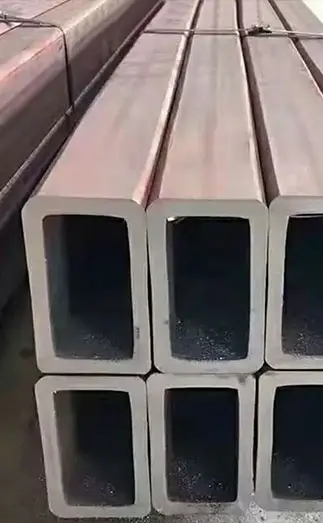
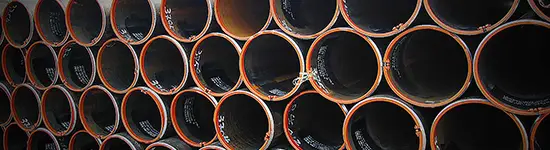
RHS steel, also known as rectangular tubing or flat-square tubing, is a hollow structural section characterized by its long, rectangular profile. With equal bending and torsional strength, RHS steel offers a lighter weight compared to other shapes, making it widely used in mechanical components and engineering structures.
What Is ASTM A500?
ASTM A500 is an ASTM International standard that specifies cold-formed welded and seamless carbon steel structural tubing.
ASTM A500 rectangular tubes refer to hollow structural sections with rectangular cross-sections produced according to this standard. Among them, ASTM A500 Grade B rectangular tubes are the most commonly used worldwide in construction and structural engineering.
Advantages of ASTM A500 RHS Steel
Excellent weldability
Good machinability
Strong cold-forming capability
Clean, aesthetic appearance
Material Properties of ASTM A500 RHS Steel
A500 carbon steel structural tubes are made from materials that meet carbon steel specifications. Their composition is primarily iron, with controlled amounts of carbon, manganese, phosphorus, sulfur, and copper to achieve the desired strength and performance.
Common Size Range of ASTM A500 RHS Steel
Long side: 2" to 20" or more
Wall thickness: 0.125" to 0.5" or thicker
Grades & Mechanical Properties of ASTM A500 RHS Steel
ASTM A500 includes four grades—A, B, C, and D—each with different strength levels:
Grades B and C are the most widely used for RHS products.
Grade B: minimum yield strength of 46,000 psi
Grade C: higher yield strength of 50,000 psi
These mechanical properties ensure excellent load-bearing capacity, pressure resistance, and deformation resistance, making ASTM A500 RHS steel suitable for both static and dynamic applications.
Chemical Requirements of ASTM A500 RHS Steel
|
Element
|
Grades A, B and D
|
Grace C
|
|
|
Heat
Analysis
|
Product
Analysis
|
Heat
Analysis
|
Product
Analysis
|
|
Carbon, max
|
0.26
|
0.30
|
0.23
|
0.27
|
|
Manganese, max
|
...
|
...
|
1.35
|
1.40
|
|
Phosphorus, max
|
0.035
|
0.045
|
0.035
|
0.045
|
|
Sulfur, max
|
0.035
|
0.045
|
0.035
|
0.045
|
|
Copper, when copper steel is specified, min
|
0.20
|
0.18
|
0.20
|
0.18
|
Tensile Requirements of ASTM A500 RHS Steel
|
|
Grade A
|
Grade B
|
Grade C
|
Grade D
|
|
Tensile strength, mn, ps (MPa)
|
45 000
(310)
|
58 000
(400)
|
62 00
(427)
|
58 000
(400)
|
|
Yield strength, mn, psi (MPa)
|
39 000
(269)
|
46 000
(317)
|
50 000
(345)
|
36 000
(250)
|
|
Elongation in 2 in. (50.8 mm), min, %A
|
25B
|
23C
|
21D
|
23C
|
A500 Outside Dimensional Tolerances for RHS Steel
|
Outside Large Flat Dimension, in. (mm)
|
Large Flat Dimension Tolerance, A plus and minus, in. (mm)
|
|
2½ (63.5) or under
|
0.020 (0.51)
|
|
Over 2½ to 3½ (63.5 to 88.9), incl
|
0.025 (0.64)
|
|
Over 3½ to 5½, inc
|
0.030 (0.76)
|
|
Over 5½ (139.7)
|
0.01 times large flat dimension
|
Twist Tolerances for RHS Steel
|
Specified Dimension of Longest Side, in. (mm)
|
Maximum Twist in the First 3 ft (1 m) and in each additional 3 ft
|
|
|
in.
|
mm
|
|
1½ (38.1) and under
|
0.050
|
1.39
|
|
Over 1½ to 2½ (38.1 to 63.5),incl
|
0.062
|
1.72
|
|
Over 2½ to 4 (63.5 to 101.6), incl
|
0.075
|
2.09
|
|
Over 4 to 6 (101.6 to 152.4), incl
|
0.087
|
2.42
|
|
Over 6 to 8 (152.4 to 203.2), incl
|
0.100
|
2.78
|
|
Over 8 (203)
|
0.112
|
3.11
|
ASTM A500 vs. Other Structural Tubing Standards
ASTM A500 is frequently compared with several other standards, each designed for different applications:
ASTM A513: Intended for mechanical tubing rather than structural applications.
ASTM A36: Covers structural profiles like I-beams and channels, not hollow tubing.
EN 10210: A European standard specifying hot-finished structural hollow sections.
In North America, ASTM A500 remains the dominant and most widely used standard for welded and seamless structural tubing.
Applications of ASTM A500 RHS Steel
Thanks to its high strength, excellent formability, and versatility, ASTM A500 rectangular tubing is used across multiple industries:
1. Construction
Commonly used in commercial, industrial, and residential structures.
Its hollow form reduces weight while maintaining strong load-bearing performance.
2. Infrastructure
Ideal for bridges, road signage, guardrails, and public railings.
Its durability and resistance to dynamic loads make it a safe and reliable choice.
3. Equipment Framing
Widely used in frames for machinery, agricultural equipment, transportation systems, and industrial equipment.
4. Furniture & Design
Valued for its sleek appearance and structural integrity.
Modern designers often use ASTM A500 RHS for industrial-style furniture and architectural features.
FAQ
1. How strong is RHS steel?
RHS steel is highly robust. Its rectangular geometry distributes stress evenly across the section, enhancing its ability to resist external pressure, bending, and torsional forces.
Compared with circular hollow sections (CHS), RHS provides a more stable cross-section under many loading conditions.
2. Is RHS steel stronger than SHS steel?
Yes—RHS is generally stronger than SHS because the longer side of the rectangular section allows it to handle greater bending forces and directional loads more efficiently than a square tube.


 English
 Español
 Français
 بالعربية