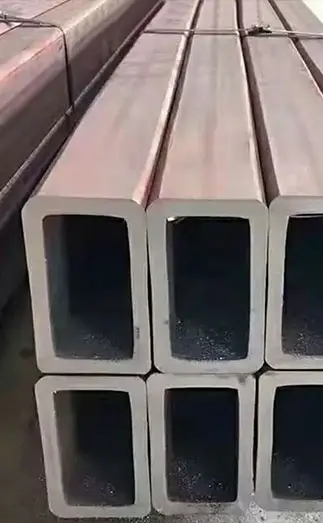
Square tubes (SHS steel) are widely used in construction, manufacturing, automotive, and other industrial sectors. Like all steel products, they may develop defects during production or use, making timely detection and correction essential. This article summarizes the most common defects found in square tubes and the methods used to identify them.
Common Defects in Square Tubes
1. Surface Cracks
Surface cracks are among the most noticeable defects.
They can form during hot rolling, cold forming, or due to improper handling and excessive external stress. These cracks weaken the tube’s structural integrity and may lead to premature failure.
2. Welding Defects
Welding issues are particularly critical for square tube welding.
Typical problems include porosity, lack of fusion, and excessive weld reinforcement.
Porosity creates tiny voids that reduce joint strength.
Lack of fusion occurs when weld metal does not fully bond, forming weak points.
Oversized reinforcement increases stress concentration and affects performance.
3. Dimensional Deviations
Square tubes must meet precise tolerances for width, length, and wall thickness. Manufacturing errors or mold wear may cause deviations, impacting assembly, load-bearing capacity, and overall fit. For instance, insufficient wall thickness may cause the tube to fail under load.
4. Internal Defects
Internal defects are hidden but highly impactful.
Inclusions result from foreign particles trapped inside the metal.
Delamination refers to layer separation within the tube wall.
Both defects reduce strength and increase the risk of cracking.
Square Tube Defect Detection Methods
1. Visual Inspection
The most basic method, used to identify cracks, scratches, dents, or corrosion.
Although simple and low-cost, visual inspection only detects surface-level issues and cannot reveal internal defects.
2. Ultrasonic Testing
A non-destructive method ideal for detecting internal issues.
High-frequency sound waves are transmitted into the tube, and changes in their reflections indicate defects such as inclusions or delamination. Ultrasonic testing offers high sensitivity and precision.
3. Magnetic Particle Testing
Suitable for ferromagnetic materials, this method reveals surface and near-surface cracks.
After magnetizing the tube and applying iron powder, defects distort the magnetic field and cause the powder to accumulate, making flaws visible. It is fast and economical but limited to ferromagnetic steels.
4. Eddy Current Testing
Effective for detecting surface and near-surface defects in conductive materials.
An alternating magnetic field induces eddy currents in the tube; variations indicate defects such as cracks or inclusions. This method is rapid and suitable for high-speed production lines but less effective for deep internal defects.
5. Dimensional Measurement
Vernier calipers, micrometers, and laser measuring devices are used to verify width, wall thickness, and length. Ensuring dimensional accuracy is essential for meeting standards and maintaining performance in real-world applications.
Summary
Identifying defects in square tubes is vital for product safety and performance. Undetected flaws may lead to structural failure, accidents, and safety risks. Effective defect detection on the production line not only prevents hazards but also ensures stable product quality and enhances manufacturer reputation.


 English
 Español
 Français
 بالعربية