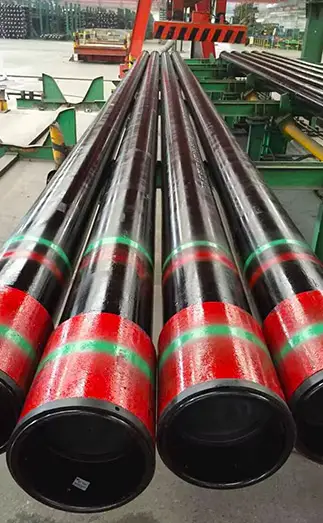
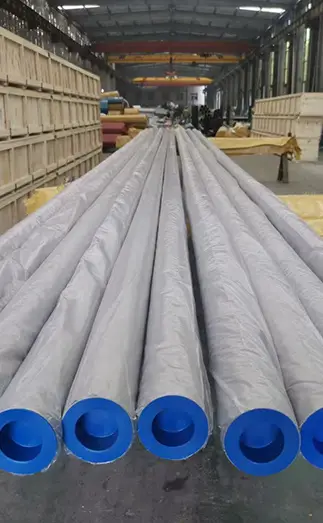
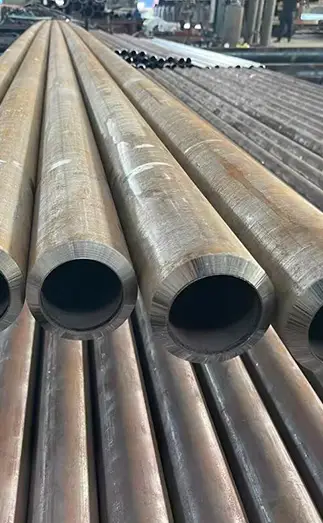
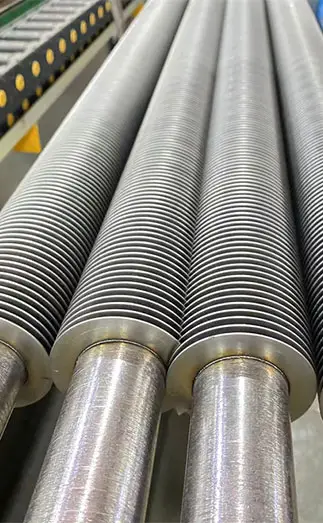
Heat treatment is essential for improving the strength, toughness, machinability, and overall performance of seamless steel pipes. Below is a clear overview of the major heat treatment methods widely used in industrial projects.
①Basic Heat Treatment Process for Seamless Steel Pipe
a. Heating:
Below Ac1: stabilizes the structure and relieves internal stress.
Above Ac3: fully austenitizes the steel.
b. Holding:
Ensures uniform internal temperature and results in a controlled microstructure.
c. Cooling:
Determines the final metallographic structure and mechanical properties. Common cooling methods include furnace cooling, air cooling, oil cooling, and water cooling.
②Normalizing Process for Seamless Steel Pipe
Normalizing heats the pipe above the austenitizing temperature, holds it, and cools it uniformly in air.
Main purposes:
Refine grains and homogenize the microstructure.
Eliminate banded structures and network carbides.
Improve machinability for carbon and low-alloy steels.
Serve as pretreatment before quenching to reduce defects.
Replace annealing for general-purpose seamless steel pipes with lower performance requirements.
③Annealing Process for Seamless Steel Pipe
Annealing heats the pipe above or below Ac3/Ac1, holds it, and slowly cools it to achieve a near-equilibrium microstructure.
Functions:
Lower hardness and strength.
Improve ductility and machinability.
Eliminate internal stress and structural inhomogeneity.
Provide a stable microstructural foundation for final heat treatment.
④Tempering Treatment for Seamless Steel Pipe
Tempering heats the pipe below Ac, holds it, and cools it appropriately to achieve a stable and tough microstructure.
Purposes:
Improve toughness and plasticity.
Reduce residual quenching stress.
Stabilize dimensions during service.
Temperature ranges:
Low tempering: 150–250°C
Medium tempering: 350–500°C
High tempering: 500–650°C
⑤Quenching Process for Seamless Steel Pipe
Quenching heats the pipe to 30–50°C above Ac3, holds it, and rapidly cools it to form martensite (M) and bainite (B).
Features:
High hardness and strength but increased brittleness.
Generates internal thermal and structural stress.
Typically followed by tempering (Q+T) to achieve balanced mechanical properties.
⑥Solution Treatment for Stainless Seamless Steel Pipe
A high-temperature quenching process used mainly for austenitic stainless seamless steel pipes.
Purpose:
Reduce hardness and strength.
Improve plasticity and toughness.
Enhance corrosion resistance.
Restore uniform austenitic structure and meet performance standards.


 English
 Español
 Français
 بالعربية