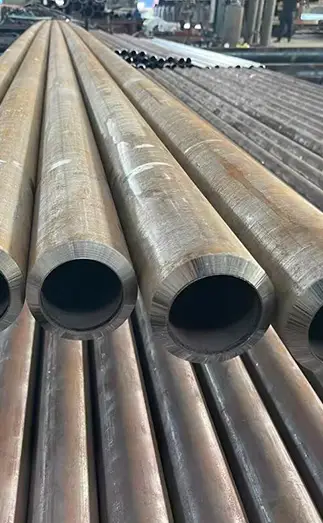
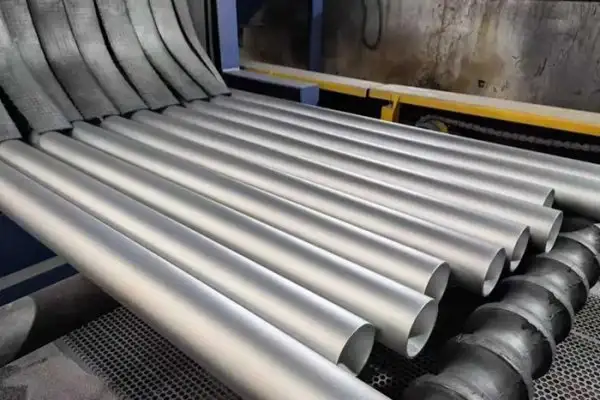
Precision seamless steel pipes—especially those in small diameters—are widely used in automotive, machinery, hydraulic systems, and other high-performance applications. Their final mechanical properties depend not only on the steel grade but also on the delivery condition (i.e., the heat treatment or cold-working state in which the pipe is supplied). Different delivery states provide different levels of strength, ductility, and dimensional stability, making it essential to select the right condition based on the intended downstream processing and end-use requirements.
Delivery Conditions of Small-Diameter Precision Seamless Steel Pipes
The original state of precision pipes can be categorized into several standardized delivery conditions: Cold-worked/Hard (BK), Cold-worked/Soft (BKW), Cold-worked Stress-Relieved Annealed (BKS), Annealed (GBK), and Normalized (NBK).
Among these, annealed (GBK) is the most commonly used because it offers balanced properties and excellent workability for subsequent processing.
Cold-Worked / Hard (BK)
BK pipes are produced through substantial cold deformation without any heat treatment. They feature high dimensional accuracy, very high tensile strength, and low elongation, making them suitable for components where hardness and rigidity are essential—such as motorcycle shock absorber sleeves and other precision structural parts.
Cold-Worked / Soft (BKW)
BKW pipes are cold-worked with only slight deformation and no heat treatment. They maintain high dimensional accuracy and moderately high strength, while providing 10–15% elongation. This makes them ideal for automotive components that require both strength and limited formability.
Cold-Worked, Stress-Relieved Annealed (BKS)
After cold working, BKS pipes undergo low-temperature rapid annealing, relieving internal stresses while retaining higher strength. They offer excellent dimensional accuracy, higher tensile strength, and elongation above 15%, suitable for general mechanical parts that demand stability and controlled ductility.
Annealed (GBK)
GBK pipes undergo a full and standard annealing process after cold working. They provide balanced mechanical properties, with normal accuracy, moderate tensile strength, and elongation above 20%.
This is the most widely used delivery state, preferred in applications where subsequent machining, bending, flaring, or welding is required.
Normalized (NBK)
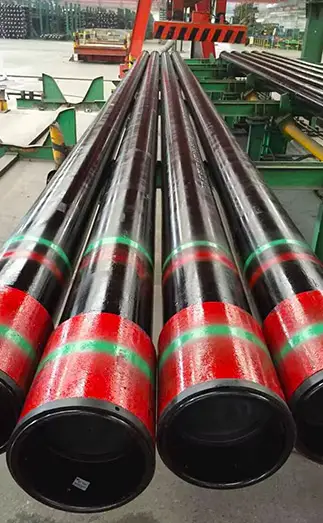
NBK pipes are fully normalized and then cooled in a controlled manner. They exhibit stable dimensional accuracy, slightly higher strength, and elongation over 20%. They are commonly used in oilfield tubing and structural mechanical parts where improved toughness and uniformity are required.
FAQs: Delivery Conditions of Small-Diameter Precision Seamless Steel Pipes
1. Which delivery condition is the most commonly used?
The most commonly used condition is GBK (Annealed) because it offers good ductility, stable performance, and excellent machinability for most downstream processing needs.
2. Does the delivery condition significantly affect the price?
In most cases, no. Pricing is mainly determined by the pipe’s specifications, precision grade, material composition, and length requirements. Delivery condition plays only a minor role.
3. How do I choose the right delivery condition for my application?
You can select based on your processing and performance needs:
BK→For parts requiring high strength and rigidity
BKW→For components needing moderate strength and some elongation
BKS→For mechanical parts needing balanced strength, elongation, and dimensional stability
GBK→For applications involving significant machining or forming
NBK→For pressure-bearing or fatigue-resistant applications (e.g., tubing)
4. Does the delivery condition influence weldability?
Yes. GBK and NBK pipes generally offer better weldability due to uniform microstructure. BK and BKW pipes may require annealing or pre-treatment before welding.


 English
 Español
 Français
 بالعربية