As modern construction and high-end equipment manufacturing continue to demand higher safety margins and durability, structural materials are required to deliver consistent mechanical performance under complex service conditions. EN 10210 hot-formed square tubes, known for their uniform cross-sectional properties, excellent toughness, and long-term reliability, are widely used in bridges, offshore structures, heavy industrial plants, and seismic-resistant buildings.
This article clarifies what EN 10210 square tubes are, how they differ from seamless square tubes, and how to select them correctly for critical applications.
Are Seamless Square Tubes the Same as EN 10210 Square Tubes?
No. The two concepts overlap but are not identical.
A seamless square tube refers specifically to a product formed integrally—via piercing, hot rolling, or cold drawing—without any weld seam. Due to their continuous structure, seamless tubes generally offer superior pressure resistance and fatigue performance.
EN 10210, by contrast, is a performance-based European standard for hot-finished structural hollow sections. It does not require the tube to be seamless; instead, it emphasizes the final hot-worked condition and uniform mechanical properties.
What Is EN 10210 Square Tube?
EN 10210 applies to hot-finished hollow sections made from non-alloy and fine-grain structural steels. These tubes are produced either by:
Seamless hot rolling, resulting in a seamless product; or
Post-weld hot working, where a welded tube is subsequently hot-expanded or hot-rolled to eliminate weld stress and homogenize the microstructure.
Because the hot-working process removes residual stress and equalizes properties across the section (including the former weld zone), EN 10210 square tubes offer excellent strength, toughness, weldability, and low-temperature impact performance—often comparable to seamless products.
Key distinction:
Seamless square tubing focuses on manufacturing method.
EN 10210 square tubing focuses on final hot-finished performance, regardless of whether it originated as seamless or welded.
Key Factors When Selecting EN 10210 Square Tubes
1. Application Scenario
EN 10210 square tubes are best suited for applications with high safety, fatigue, or durability requirements, such as:
Load-bearing building structures and frames
Bridges, crane booms, and fatigue-sensitive components
Offshore platforms, chemical facilities, and low-temperature environments
For standard static structures with tight budgets, EN 10219 cold-formed welded tubes may be a more economical alternative.
2. Size and Wall Thickness
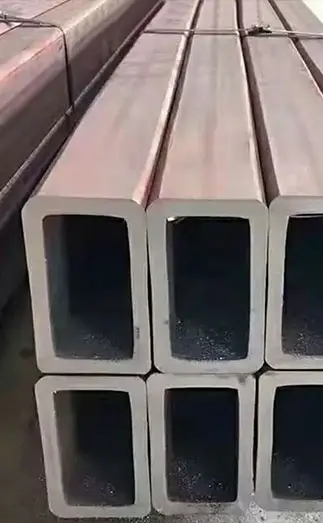
Specifications are expressed as side length × side length × wall thickness × length (e.g., 130 × 130 × 4–8 mm).
Wall thickness should be determined through structural calculations to balance strength, stiffness, and cost.
Recommendation: For critical components, clearly specify wall thickness tolerances and consider requiring a guaranteed minimum thickness.
3. Steel Grade and Mechanical Performance
Common EN 10210 grades include S235, S275, and S355, with S355J2H being the most widely used due to its strong balance of strength and low-temperature toughness.
Always request EN 10210-compliant material certificates (EN 10204 3.1 or 3.2) and verify:
Chemical composition
Yield and tensile strength
Impact test results (KV values)
4. Surface Condition and Corrosion Protection
Hot-finished square tubes are typically supplied with a mill scale (black surface) or shot-blasted finish. Corrosion protection should be selected according to ISO 12944 environmental categories:
C2–C3: Coating systems
C4–C5: Hot-dip galvanizing or galvanizing plus coating systems
Proper surface treatment significantly extends service life in aggressive environments.
5. Supplier Qualification
Choose suppliers with proven production capability, stable quality control systems, and full EN 10210 certification. Confirm their inspection procedures, testing scope, and delivery reliability.
6. Budget Considerations
EN 10210 square tubes are more expensive than ordinary welded products, but their superior performance reduces structural risk, maintenance costs, and lifecycle expenses—making them a cost-effective choice for critical projects.
Frequently Asked Questions (Condensed)
1. Common EN 10210 grades?
S235J2H, S275J2H, S355J2H (most common), S355K2H, S460NH.
2. When should EN 10210 be prioritized?
Critical load-bearing structures, fatigue-loaded components, harsh environments, seismic zones, and complex welded joints.
3. Required quality documents?
EN 10204 3.1 or 3.2 certificates covering chemistry, mechanical properties, impact tests, and dimensional checks.
4. Marine applications—what to choose?
S355J2H or S355K2H with hot-dip galvanizing or heavy-duty epoxy coating.
5. Small batches or special sizes?
Possible but usually require higher prices, longer lead times, and minimum order quantities.
Conclusion
Selecting EN 10210 hot-finished structural square tubing requires a comprehensive evaluation of application conditions, dimensions, steel grade, corrosion protection, supplier reliability, and budget. When chosen correctly, EN 10210 square tubes provide outstanding safety, durability, and long-term value for demanding structural applications.


 English
 Español
 Français
 بالعربية