Cold-formed rectangular steel pipes are among the most widely used structural hollow sections in modern construction and industrial manufacturing. Thanks to their high dimensional accuracy, smooth surface quality, and cost efficiency, they have become the preferred choice for most standard structural and mechanical applications worldwide.
In this article, we will explain what cold-formed rectangular steel pipes are, how they are manufactured, their key advantages and limitations, applicable standards, and how they compare with hot-formed rectangular tubes—helping engineers, buyers, and project managers make informed decisions.
What Is a Cold-Formed Rectangular Steel Pipe?
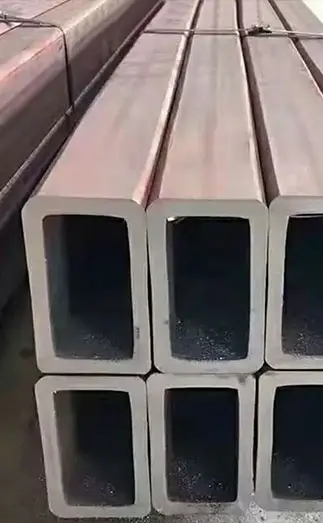
A cold-formed rectangular steel pipe is a hollow steel section manufactured by forming steel strip or plate into a rectangular shape at room temperature using continuous roll-forming equipment. The formed section is then closed by high-frequency welding (HFW) to create a longitudinal seam.
Unlike hot-formed tubes, cold-formed rectangular pipes are produced without heating, which allows for tighter dimensional tolerances, smoother surfaces, and higher production efficiency.
Typical manufacturing steps include:
Steel strip preparation
Cold roll forming at room temperature
High-frequency welding
Sizing and straightening
Cutting to length
Surface treatment (black, galvanized, painted)
Key Advantages of Cold-Formed Rectangular Steel Pipes
High Dimensional Accuracy and Smooth Surface
Cold roll forming allows precise control of width, height, and wall thickness. The absence of hot-rolling scale results in a clean surface suitable for direct coating.
Surface roughness: Ra ≤ 0.8 μm
Excellent coating adhesion
Improved corrosion resistance compared with untreated hot-rolled tubes
Cost-Effective and Energy Efficient Production
Because no reheating is required, cold forming significantly reduces energy consumption and overall production cost.
Approximately 40% lower energy usage than hot-formed tubes
High material utilization
Ideal for large-volume projects
Flexible Section Design
Cold-forming lines can easily produce different rectangular and square tube sizes by changing rolls, allowing fast response to market demand and customized orders.
Optimized Structural Performance
By adjusting forming parameters, manufacturers can control corner radius, corner thickness, and section modulus to meet structural design requirements.
Limitations of Cold-Formed Rectangular Tubes
While cold-formed rectangular steel pipes are suitable for most applications, some limitations should be considered:
Longitudinal weld seam may be weaker than seamless material under extreme pressure or high-cycle fatigue
Residual stress introduced during cold forming may affect secondary processing
Size and thickness limitations, especially for very thick walls or oversized sections
Reduced corner toughness compared to flat areas, particularly in low-temperature environments
Applicable Standards for Cold-Formed Rectangular Steel Pipes
Cold-formed rectangular steel pipes are produced under widely recognized international standards:
EN 10219 – Cold-formed welded structural hollow sections (Europe)
ASTM A500 – Cold-formed welded and seamless carbon steel structural tubing (USA)
GB/T 6728 – Cold-formed hollow sections for structural purposes (China)
Among these, EN 10219 is the most commonly referenced standard for global structural projects.
Typical Applications of Cold-Formed Rectangular Steel Pipes
Thanks to their excellent balance of performance and cost, cold-formed rectangular steel pipes are used across multiple industries:
- Building and Construction
Steel beams and columns
Curtain wall framing
Roof trusses and space frames
Stair railings and handrails
For coastal or humid environments, galvanized pipes with zinc coating ≥ 80 g/m² are recommended.
- Machinery and Equipment Manufacturing
Machine frames and supports
Conveyor systems
Automated equipment guide rails
High-precision cold-formed tubes are especially suitable for automated and modular equipment structures.
- New Energy and Renewable Projects
Photovoltaic mounting systems
Solar support structures
Common sizes such as 60×40×2.5 mm are widely used.
Transportation and Infrastructure
Vehicle frames and chassis components
Bridge railings and lighting poles
Traffic and signal towers
- Furniture and Interior Decoration
Metal furniture frames
Display racks
Stair and balcony handrails
Cold-Formed vs. Hot-Formed Rectangular Steel Tubes
Understanding the difference between cold-formed and hot-formed rectangular tubes is critical when selecting materials:
Cold-Formed Rectangular Tubes
Manufacturing: Cold roll forming + welding
Advantages: High accuracy, smooth surface, lower cost
Typical standard: EN 10219
Hot-Formed Rectangular Tubes
Manufacturing: Hot rolling, extrusion, or hot expansion
Advantages: Better toughness, lower residual stress
Typical standard: EN 10210
Cold-formed tubes are preferred for standard structural and mechanical applications, while hot-formed tubes are typically selected for extreme load, low-temperature, or fatigue-critical conditions.
How to Choose the Right Rectangular Steel Pipe for Your Project
When selecting rectangular steel pipes, consider the following factors:
Load and structural requirements
Environmental conditions (corrosion, temperature)
Required standards and certifications
Budget and project scale
For most cost-sensitive, high-volume projects, cold-formed rectangular steel pipes under EN 10219 or ASTM A500 are the optimal solution.
Frequently Asked Questions (FAQ)
Are cold-formed rectangular steel pipes suitable for load-bearing structures?
Yes. When manufactured according to EN 10219 or ASTM A500, they are widely used in load-bearing structural applications.
Is the weld seam a quality risk?
For standard applications, no. Modern high-frequency welding ensures stable and reliable seam quality. Seamless or hot-formed tubes are recommended only for extreme service conditions.
Can cold-formed rectangular steel pipes be galvanized?
Yes. They can be hot-dip galvanized or pre-galvanized for improved corrosion resistance.
What is the difference between EN 10219 and EN 10210?
EN 10219 covers cold-formed tubes, focusing on efficiency and cost. EN 10210 covers hot-formed tubes with better toughness and lower residual stress.
Which industries use cold-formed rectangular steel pipes the most?
Construction, machinery manufacturing, renewable energy, transportation, warehousing, and furniture industries.
Final Thoughts
Cold-formed rectangular steel pipes offer an ideal combination of precision, efficiency, and affordability, making them the dominant choice for rectangular hollow sections in global markets. For most structural and mechanical applications, they deliver reliable performance while keeping project costs under control.
If your project does not involve extreme temperatures, heavy fatigue loading, or special pressure conditions, cold-formed rectangular steel pipes are the most practical and economical option.


 English
 Español
 Français
 بالعربية